The eleventh island
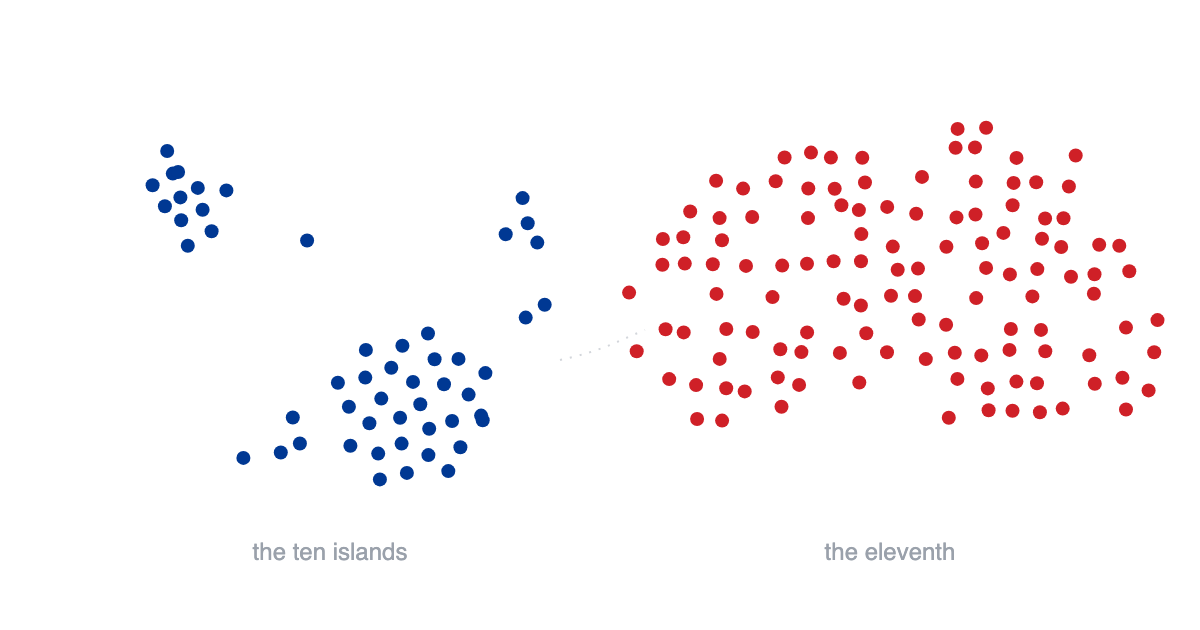
Football's World Cup no longer maps a world of nations. It maps the world that quietly replaced it — and rations who may enter.
On June 27th some of the loudest celebrations of Cape Verde's greatest sporting day took place 3,600 miles from Cape Verde. When the islands' footballers reached the knockout rounds of the World Cup — the smallest nation ever to do so — the street parties in Praia, the capital, had rivals in Brockton, Massachusetts, home to one of the largest Cape Verdean communities on earth. Nobody in Brockton found this strange. Cape Verdeans have long said that their diaspora, which by most estimates outnumbers the islands' 525,000 residents, is the country's "eleventh island". At this World Cup the eleventh island supplied the team: 14 of the 26 players were born abroad, none plays in the domestic league, and the captain, Roberto "Pico" Lopes, a Dubliner, was recruited in 2019 by a LinkedIn message he initially took for a hoax.
Cape Verde is not the exception at this tournament. It is the design, made visible. The 2026 World Cup, which concludes at MetLife Stadium on July 19th, is simultaneously three things that sound contradictory: the most transnational sporting event ever staged, the most commercially successful edition of the national format in history, and — for fans, if not for players — the most tightly gated. No previous host has legally barred the supporters of teams playing in the tournament; this one bars several. These are not contradictions. They are the same fact, viewed from the squad list, the turnstile and the visa queue.
One in four
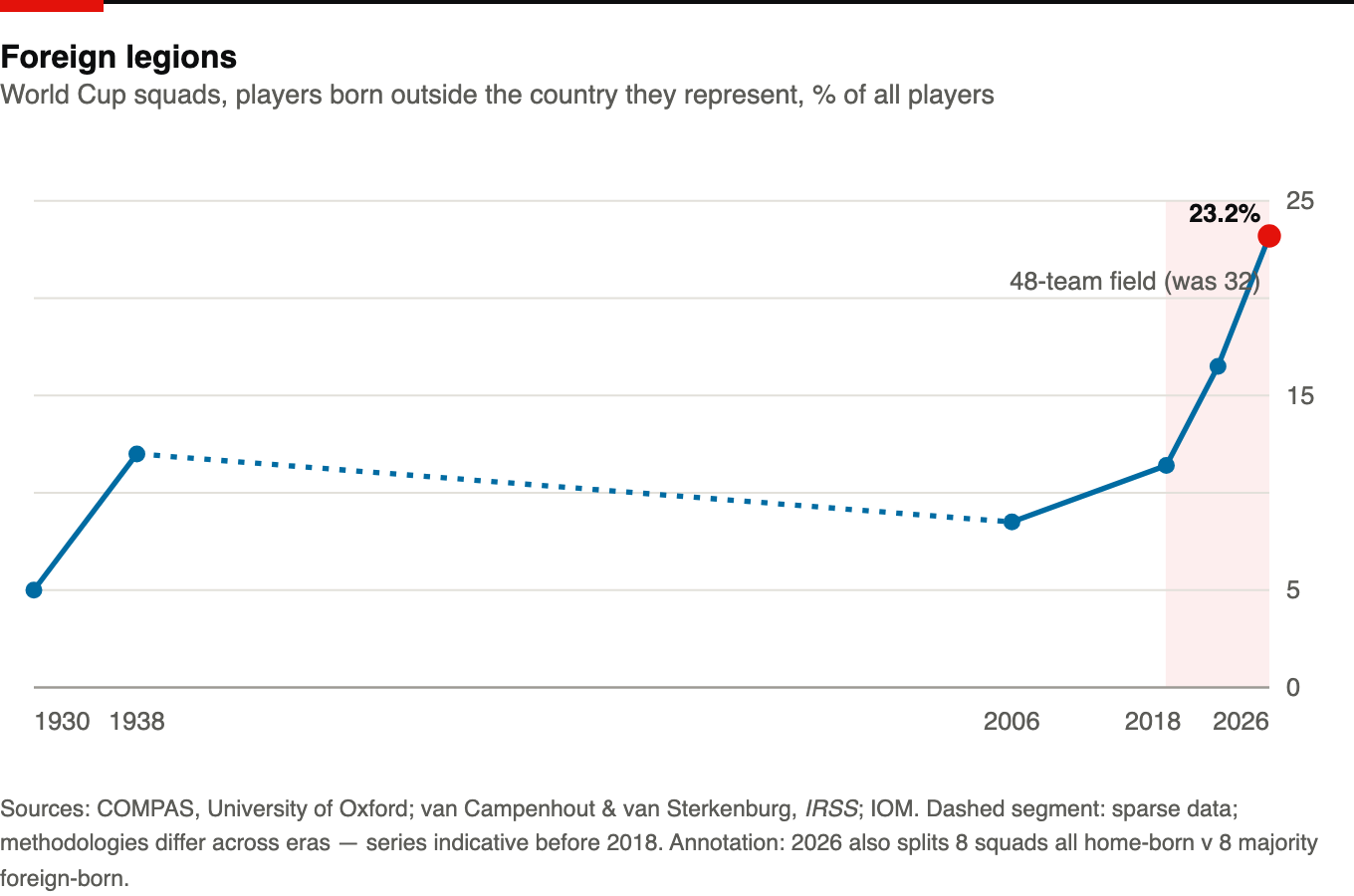
Start with the squad lists. Of the 1,248 players registered for the tournament, 289 — 23.2%, nearly one in four — were born in a country other than the one they represent, according to an analysis by Oxford University's Centre on Migration, Policy and Society. At the 2006 World Cup the share was below 9%; in Qatar in 2022 it was 16.5%. Part of the jump is arithmetic: expanding the tournament from 32 to 48 teams admitted debutants such as Cape Verde and Curaçao, whose teams are diaspora projects. But the trend holds among the old guard too, and the symmetry is neat. Exactly eight squads contain no foreign-born player at all (Brazil, Colombia, Panama, Austria, Sweden, Czechia, Saudi Arabia and South Africa). Exactly eight are majority-foreign-born, led by Curaçao, whose 26-man squad contains 25 players born in the Netherlands and one — Tahith Chong — born on the island itself.
The labour market underneath is more lopsided still. Some 73% of the tournament's players are employed outside the country they represent, according to figures compiled from the official squad lists — up from a 26% share in 1990; by Transfermarkt-based research, not a single member of England's or Spain's 1998 squads played abroad. Six squads arrived without one player from their own domestic league. A national team, in employment terms, is now a reunion of emigrants — which is why each squad list reads as an involuntary census of migrations that sending and receiving states rarely total up. France's empire appears as Algeria's 13 French-born players; the Dutch guest-worker era as Morocco's Rotterdam-raised midfielders; Haiti's state collapse as a team that played its "home" qualifiers in Curaçao because Port-au-Prince could not stage them.
The Paris supply chain
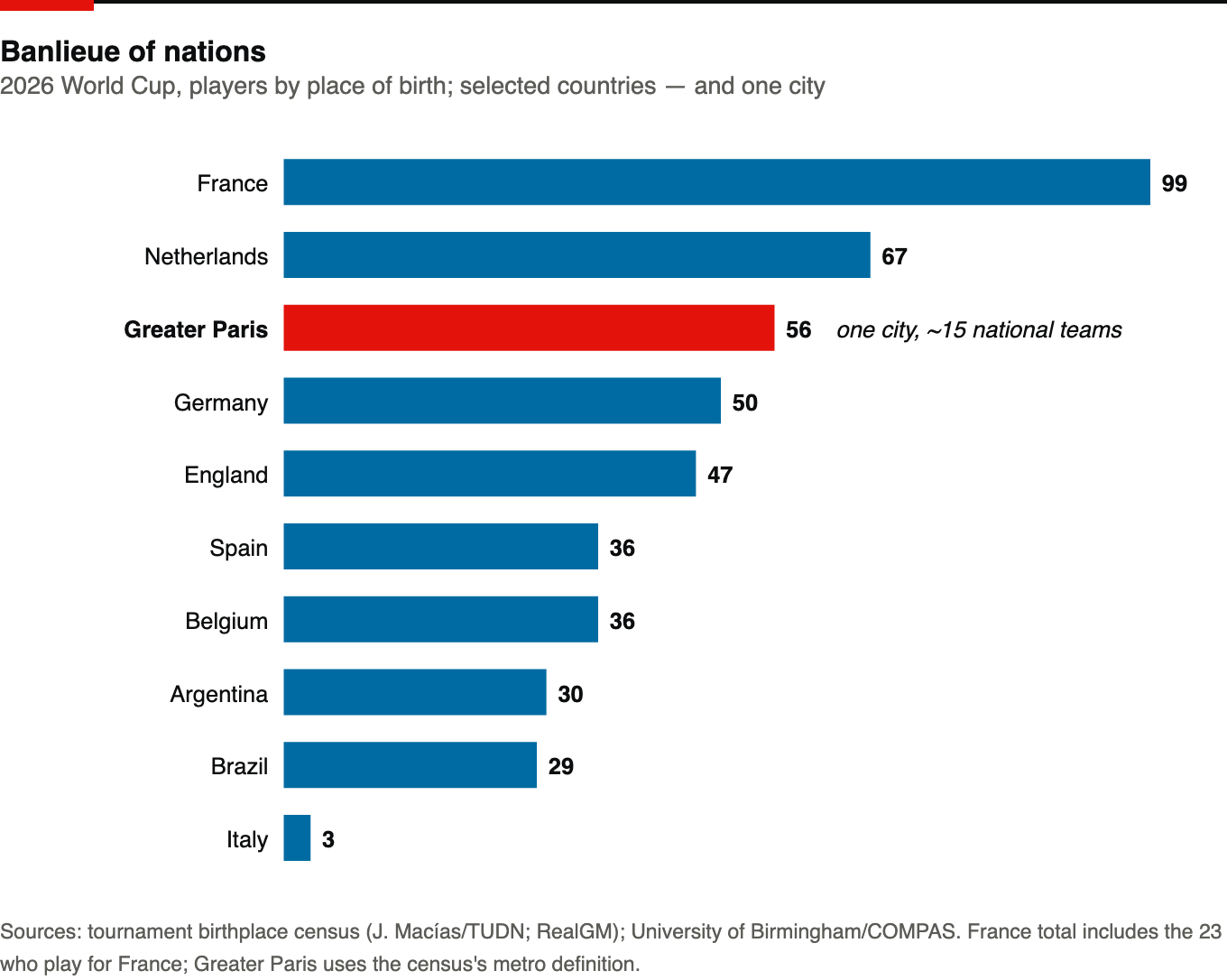
Plot the players' birthplaces and the tournament's real geography emerges. It is not a map of 48 nations but a hub-and-spoke network, and the hub is unambiguous. Some 99 players at this World Cup were born in France; only 23 of them play for France. Greater Paris alone produced 56 players — 4.3% of the entire tournament, spread across roughly 15 national teams. All of Italy produced three. One metropolis's suburbs now function as the football hinterland of two continents: 13 of the Paris region's sons play for Algeria, 12 for Haiti, ten for Senegal, ten or so for Congo.
The concentration runs through every layer. Almost half of all players at this "world" cup were born in Europe. Six western European countries — France, the Netherlands, Germany, England, Spain and Belgium — supplied 64% of all its foreign-born players. Nearly two-thirds of players are employed in Europe; England's leagues alone employ one in six. And the corridors that carry them are not random: peer-reviewed work by Gijs van Campenhout and Jacco van Sterkenburg finds that foreign-born selection "echoes or reverses" historical migration flows between country pairs. The 2026 corridor table is a typology of 20th-century migration itself: colonial (France to its former African possessions), labour (the Netherlands to Cape Verde — Rotterdam's docks, not Lisbon's empire, supply the islands' biggest contingent), constitutional (the Netherlands to Curaçao, via a shared passport), refugee (Sweden to Iraq, Germany to Bosnia).
Empire explains less than expected. Congo's squad draws twice as many players from France as from Belgium, its former coloniser: language and the scale of the French academy system beat imperial lineage. Spain's supposedly deep corridor to Latin America has nearly vanished — by one count it supplied just three players — while its corridor to Morocco, built by labour migration since the 1990s, thrives. What persists from empire is not sentiment but infrastructure: languages, citizenship statutes, flight routes and academies. When the infrastructure moves, the corridor moves within a generation.
The grandmother rule
The conclusion usually drawn from all this — that national identity is dissolving — is exactly backwards. The interesting question is why a tournament so demographically post-national keeps producing record quantities of national feeling. The Olympics offers the controlled experiment. Olympic eligibility is, in essence, whatever a passport says; and since some states sell passports, Olympic nationality is liquid. Bahrain fields Kenyan-born runners; Qatar has fielded Bulgarian-born weightlifters; nobody weeps for either. FIFA, almost uniquely among global institutions, refuses to accept the passport as sufficient. Its eligibility rules demand a "genuine link" — birth, a parent, a grandparent, or years of residence — and permit exactly one change of association per lifetime, on strict conditions.
The Olympics takes the state's word; FIFA insists on the grandmother.
The economics of this are underrated. The value of belonging lies in its illiquidity. Because a player cannot simply be bought, every diaspora recruit reads as a homecoming rather than a transfer — which is why Curaçao's Gervane Kastaneer, born in Rotterdam, could say of his debut, "I was already crying long before the anthems," and be believed. The one experiment in making football belonging tradeable proved the rule from the other direction. "Fan tokens", sold by clubs and federations as digital membership, behaved instead like leveraged bets: Argentina's official token fell by 31% during the ninety minutes of its shock 2022 defeat by Saudi Arabia, and Paris Saint-Germain's has lost more than 90% of its peak value. Academic studies concluded that the tokens tracked crypto markets and match results, not fandom. Liquidity, the crypto industry's core feature, dissolved the very commitment it was trying to tokenise. FIFA's one-switch rule, by contrast, is engineered scarcity of exit — and scarcity of exit is what makes Brahim Díaz's declaration that he feels "100% Spanish and 100% Moroccan" poignant rather than cheap: he may feel both, but he was allowed to choose once.
Flags for identities, borders for bodies
The tournament's real exclusions operate one layer down, at the border. The American travel proclamation of June 2025, expanded last December to 39 countries, contains a carve-out that will interest future historians: players, officials and their immediate families are exempt; spectators are not. Four qualified nations sit on the list. Iran's team thus trained in Tijuana and commuted to its matches, while ordinary Iranian fans were barred; the federation's ticket allocation, it says, was cancelled under American sanctions rules. The crowds that greeted the team in Los Angeles — "Tehrangeles" hosts the largest Iranian community abroad — booed the Islamic Republic's anthem and flew the pre-revolutionary flag that FIFA had banned from stadiums. Haiti, at its first World Cup since 1974, qualified without playing a single match on home soil, brought one domestically based player, and its supporters in America spent the group stage under the threat of revoked protected status. The team of a state its fans cannot follow; the fans of a state that barely functions: the tournament staged both.
For those merely inconvenienced rather than banned, the queue did the work. American visitor-visa interviews in June averaged 11 months' wait in Bogotá and 11.5 in Abuja — for a six-week tournament. Canada approved 41% of World Cup-linked visa applications, and fewer than 11% of Ghanaian ones. Five African federations' fans faced visa bonds of up to $15,000 before a partial climb-down. Meanwhile Curaçao's supporters, holding Dutch passports, strolled through — the only debutant whose fans faced no friction, for the same constitutional reason its players were raised in Dutch academies. Passport arbitrage operates in the stands exactly as on the pitch.
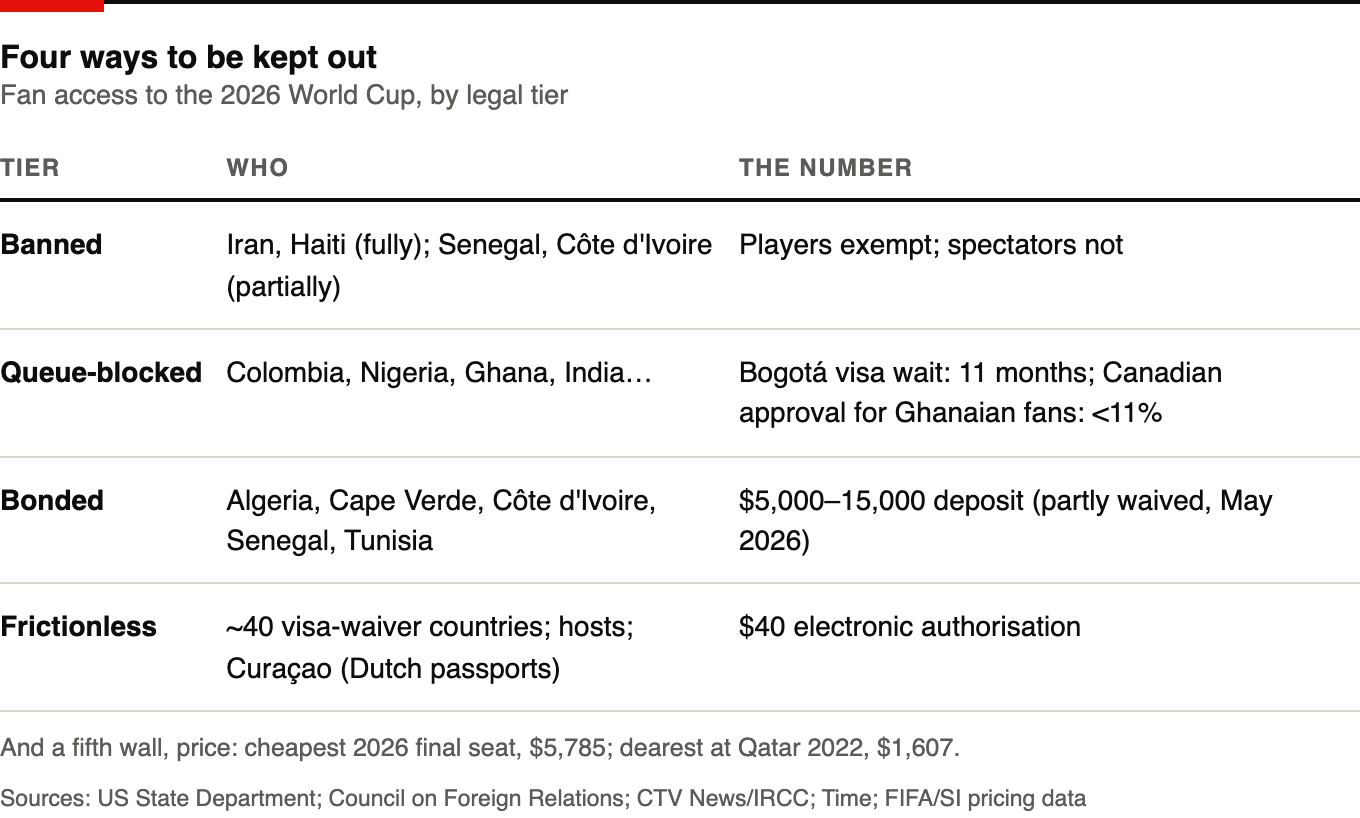
Then there is price. FIFA's first experiment with dynamic pricing lifted the cheapest final ticket to $5,785 by April, from a promised $1,550 in the bid book: the cheapest seat at this final costs more than the most expensive seat at the last one. The attorneys-general of four American states have opened an investigation into the pricing. A frugal trip from Lagos runs, by our arithmetic, at four to five times Nigeria's GDP per head; from London, about a tenth. Yet the stadiums were full — a record 4.6m group-stage attendance at 99.7% of capacity, on FIFA's count. The explanation resolves the apparent paradox: the audience mostly did not need to cross borders, because it was already inside them. When the Copa América (2024) and FIFA's Club World Cup (2025) priced tickets high in the same American cities, stadiums sat a third empty. For 2026, FIFA added a $60 ticket tier, and America's Mexican, Colombian, Haitian, Cape Verdean and Moroccan communities did the rest. Every away team, as one commentator put it, secretly played at home. The tournament did not bring the world to America. It revealed that the world already lives there — and that its poorer relations watch on screens.
The team that wasn't there
The starkest illustration of the new dispensation is a team that never arrived. Nigeria, population 230m, lost its qualification playoff on penalties to Congo — a squad built almost entirely in France, Belgium and England — and then lodged a complaint with FIFA alleging that its opponent had fielded ineligible dual-nationals. FIFA has not upheld it. Nigeria was protesting the strategy rather than playing it. The Nigeria-eligible talent at this World Cup, wearing other flags, would embarrass most contenders: Bukayo Saka, Eberechi Eze and Noni Madueke (England), Michael Olise (France), Folarin Balogun (America), David Alaba and Carney Chukwuemeka (Austria), Antonio Nusa (Norway), Tani Oluwaseyi (Canada) and Ime Okon (South Africa). Ten players, seven flags, no Super Eagles.
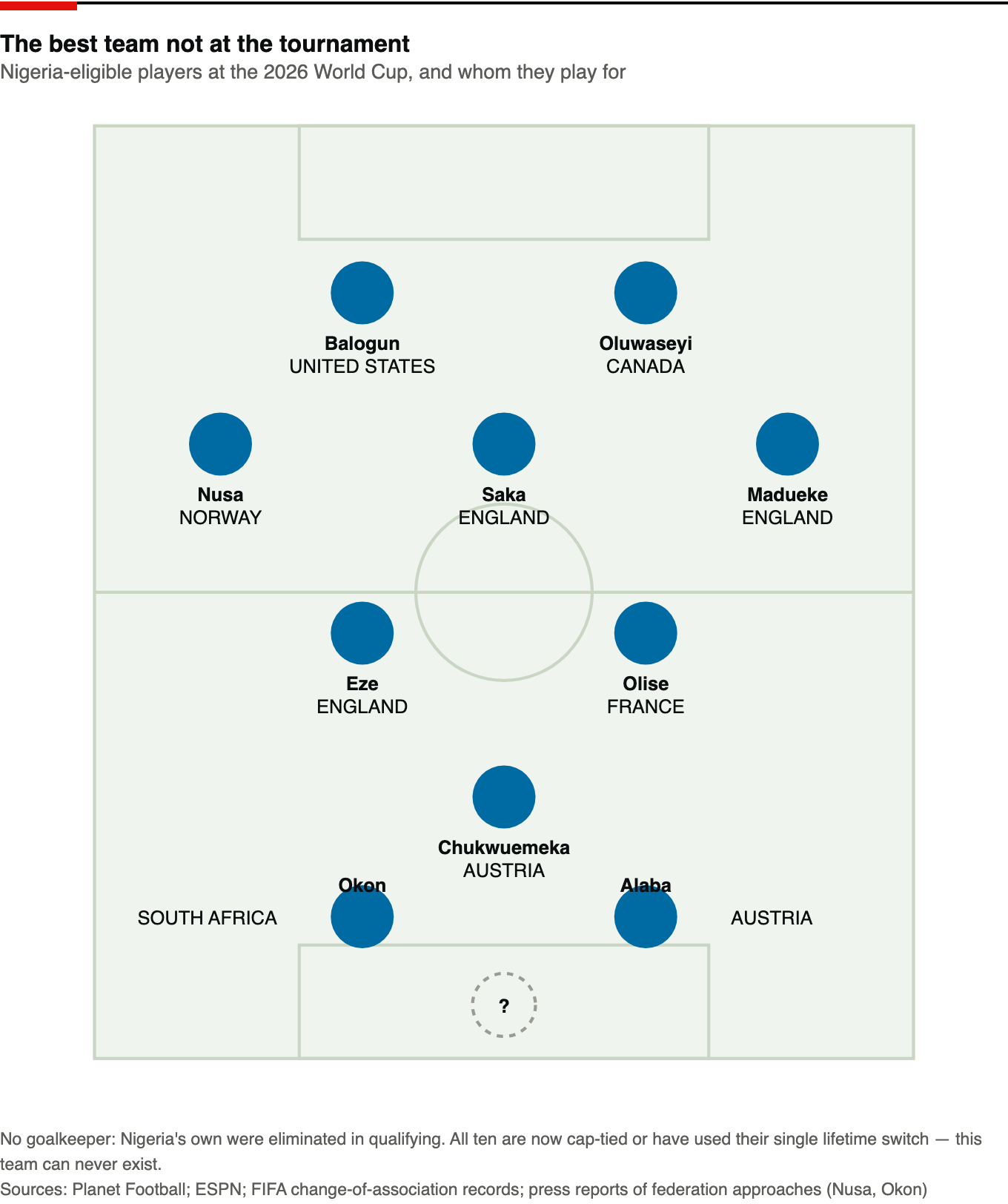
The window for such players is narrow: FIFA's rules tie a player permanently once he appears at a senior final tournament, so the contest for allegiance is fought between ages 16 and 20 — one reason England now caps teenagers with conspicuous haste. And the deciding variable, on the evidence of the players' own explanations, is not money but trust. Nusa and Okon did not decline Nigeria; they declined its federation's chaos. Morocco, the model, understood this: its Mohammed VI academy outside Rabat functions less as a school than as a credibility signal to diaspora families weighing an irreversible choice, and 19 of its 26 players — a squad that reached the quarter-finals — were born abroad.
Herein lies a genuine opportunity for the countries that supply the world's football labour. The corridor system exists regardless; the question is who benefits. A federation that paired honest governance with what might be called legacy compensation — a hospital or academy built in a recruit's ancestral region, rather than cash that would cheapen the choice — could convert its symbolic asset, the flag, into infrastructure for its residents. The motive is already there: "Your family, they grew up in Cape Verde. They sacrificed everything to come to France, and now I can give back," says Steven Moreira, Cape Verde's Paris-born defender. Two cautions apply: a team recruited abroad without academies at home is a Potemkin indicator, not development; and if the strategy works too well, FIFA has form for tightening the rules. Even so, the constraint is not talent — Nigeria's diaspora alone could staff a semi-finalist. The constraint is being the kind of institution a 17-year-old, and his mother, will bet a lifetime's single switch on.
The clearing house
Why is all this happening in America, a country where football ranks a distant fifth? Because the World Cup needed America's rails, not its passion. The tournament's two largest media cheques are American (Fox and Telemundo, roughly $950m combined); its record hospitality programme is run from America; its tickets are priced, dynamically, in dollars; its venues were pre-built by the NFL. Football's labour lives in Europe; its monetisation event settles in dollars — a eurodollar structure with shin pads. And America offers the one thing no other host can: it is the only country where the world's peoples and the world's purchasing power are the same crowd. Diaspora fans could meet dynamic prices because they earn dollars; their cousins at home, paid in naira and gourdes, could not. Qatar's World Cup was built by migrants; America's was bought by them.
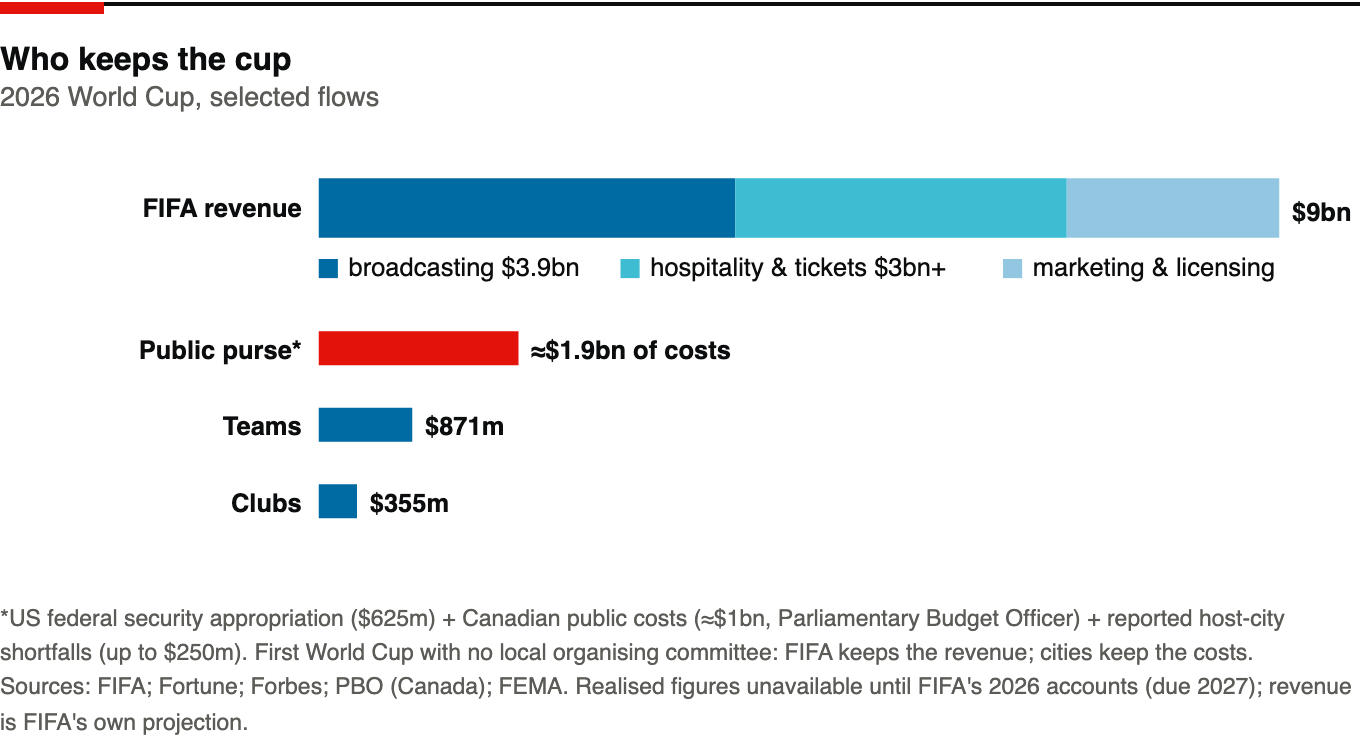
FIFA, for its part, operated this World Cup for the first time with no local organising committee, keeping the revenue — some $9bn — while host cities kept the costs. Prize and participation money, at $871m, is under a tenth of takings. The president of the United States, whose government decided which nations' fans could attend, received $15,000 in FIFA tickets, according to his financial disclosure, and will co-present the trophy.
The final, on July 19th, will be followed in nearly every country on earth, including many whose citizens could not have entered the stadium on any income. That, in the end, is the tournament's truest self-portrait. The World Cup is no longer a competition among the world's nations, if it ever was. It is the quadrennial general meeting of the Atlantic migration system, holding the world's proxies — and the proxies are real: real dignity for Haiti, real reunion for Brockton, real recognition for a ten-island republic whose eleventh island finally took the field. The scandal is not that the World Cup misdescribes the world. It is that this concentrated, gated, dollar-priced festival remains the only place where the world's scattered peoples can gather under their own names and be seen. The map is obsolete. The X-ray is exact. Football, uniquely, sells both in a single ticket — to those who can get one.